I Finally Tried a Pawpaw — Now I Want to Grow One!
How to grow pawpaws from seed, choose a tree, and actually get fruit in a northern garden
I am officially late to the pawpaw party.
Recently, I traded a pawpaw for duck eggs, which may be one of the most gardener/homesteader transactions I’ve ever made.
But here's the funny part: I had never actually eaten a pawpaw before.
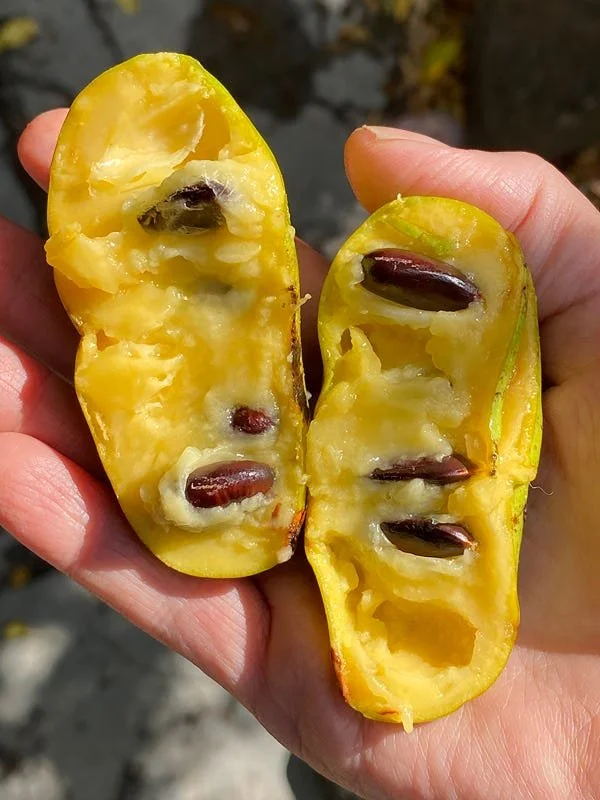
Today I finally cut it open and tried it.
Banana pudding.
That is the best way I can describe it. Soft, creamy, custardy, sweet - and absolutely delicious.
And naturally, within approximately five minutes my gardener brain went from:
“Wow, this is good!”
to:
“WAIT. Can I grow this?”
The answer for many of us northern gardeners is YES.
And now I have seeds sitting right in front of me, so you can probably guess what I'm going to try next.
Wait — Pawpaws Grow in Michigan?
This was one of the things that surprised me most.
The North American pawpaw (Asimina triloba) looks and tastes like something that belongs somewhere tropical, but it's actually a native North American tree. Michigan State University lists pawpaw as native to Michigan, with its natural Michigan range concentrated in the southern Lower Peninsula. MSU describes the fruit as having a banana-like flavor and notes that mature trees are rarely taller than about 30 feet.
Kentucky State University's Pawpaw Research Program says pawpaws can be successfully grown in USDA Zones 5–8, with their wild range extending north into southern Michigan.
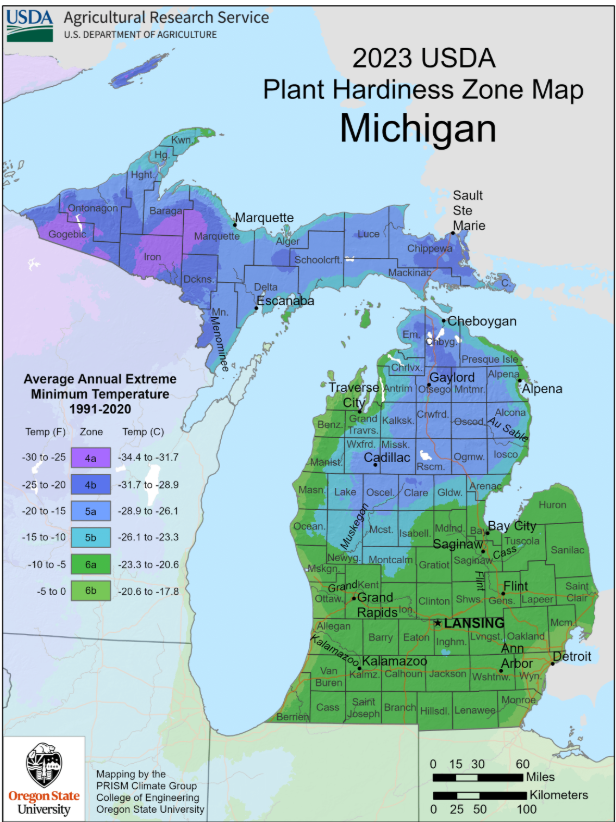
In other words, this isn't a tropical tree we're trying to convince to survive a Michigan winter.
It belongs here.
That's exciting news for gardeners who want more than apples, pears and cherries in their edible landscape.
What Does a Pawpaw Tree Look Like?
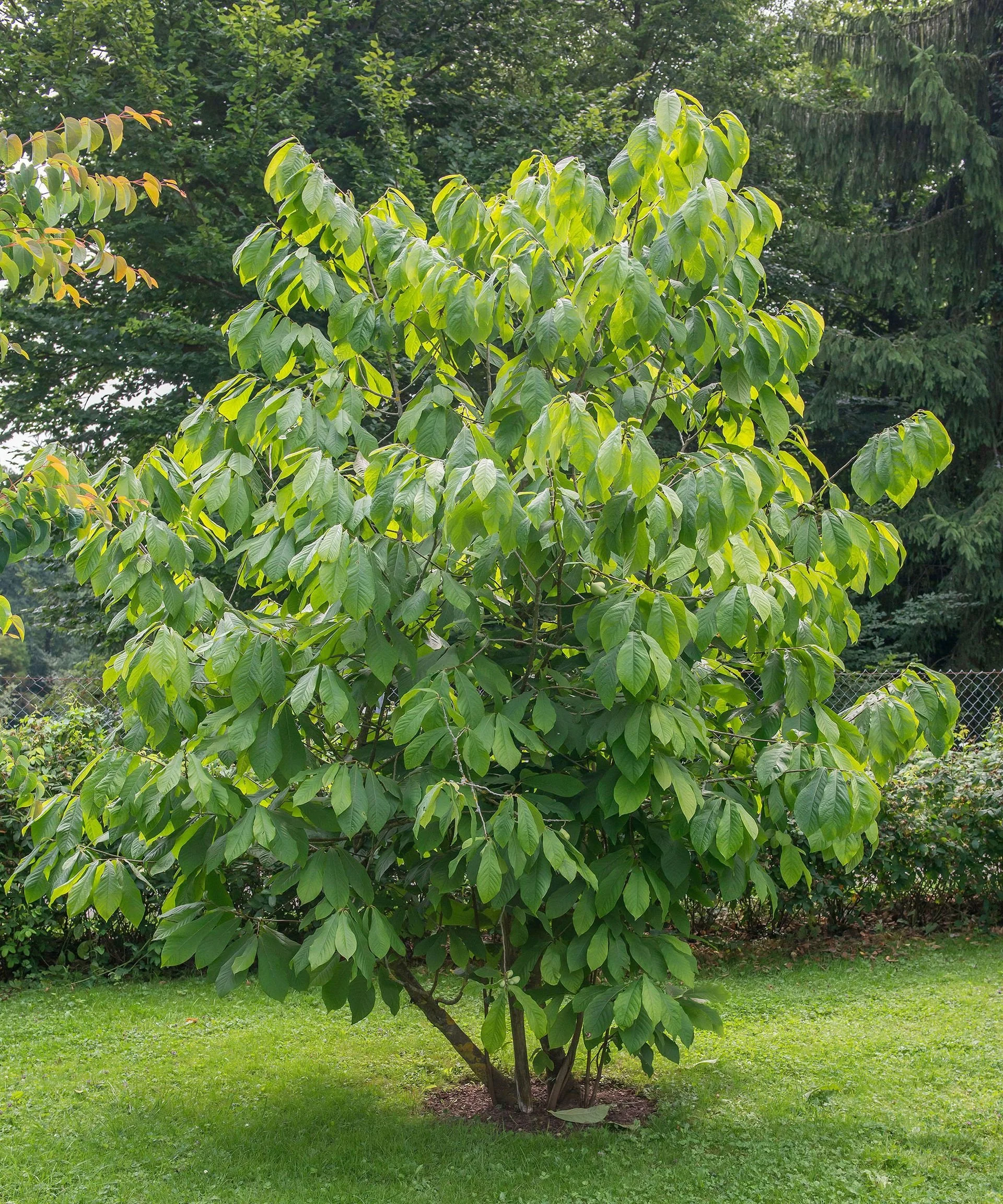
Pawpaws have a really beautiful, almost tropical appearance. Their leaves can grow close to a foot long, giving the trees that lush look you don't normally associate with a cold-hardy fruit tree.
One important identification point: pawpaw leaves are simple, entire leaves — not compound leaves with multiple leaflets. Ohio State describes them as large, dark-green, simple leaves with smooth margins.
That's important because one of the pawpaw identification graphics floating around online incorrectly shows pawpaw as having palmate leaves with several leaflets.
It doesn't.
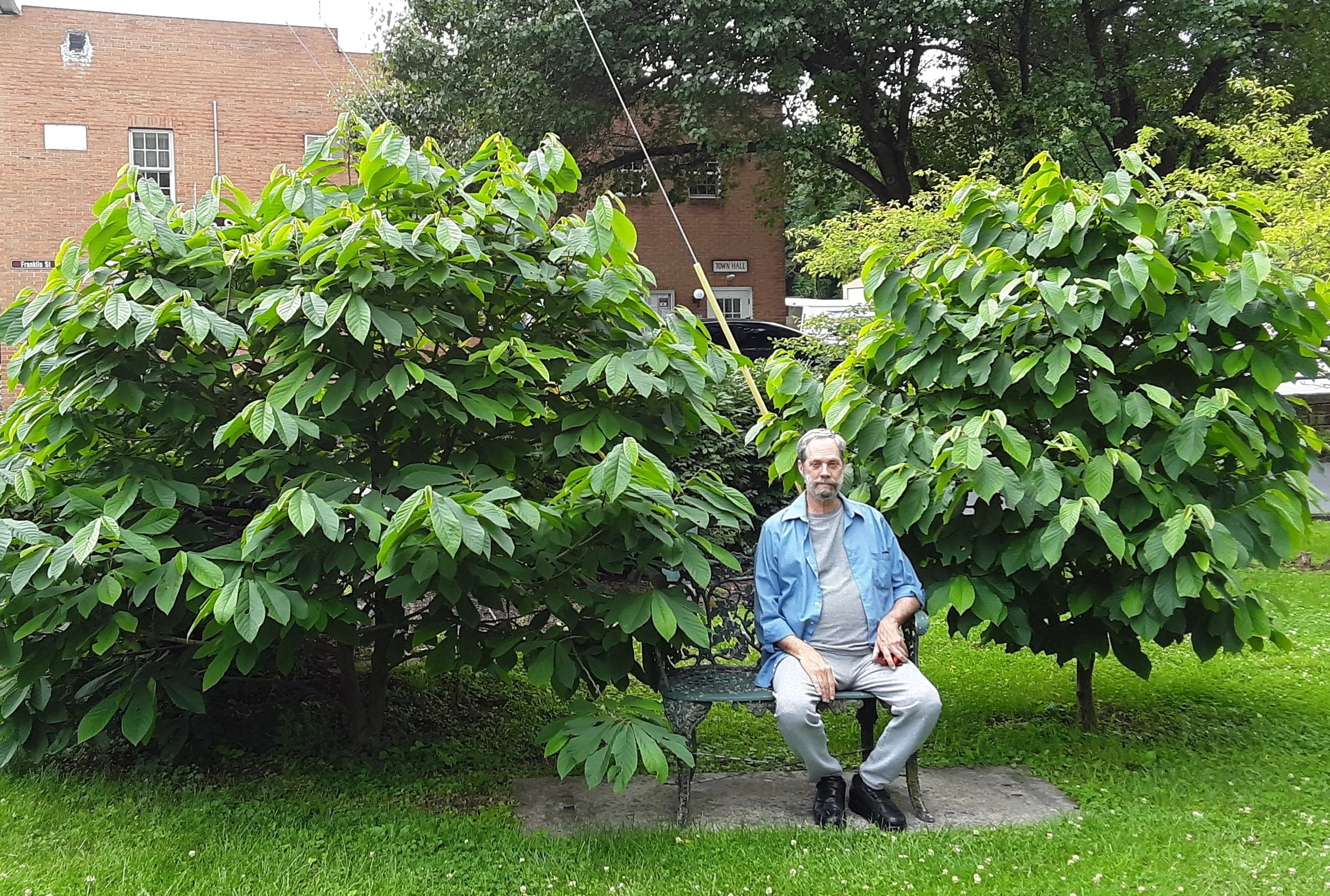
Two large trees with person for scale
Depending on growing conditions, you can generally expect something in the neighborhood of 15–30 feet tall. Trees growing in sun tend to develop a fuller, more pyramidal shape, while trees in woodland shade often grow more openly.
That's a pretty manageable fruit tree for an edible landscape.
And Look at Those Flowers!
Before the big leaves appear, pawpaws produce unusual maroon-to-purple flowers.
They don't look much like apple or peach blossoms — and they aren't trying to attract the same pollinators.
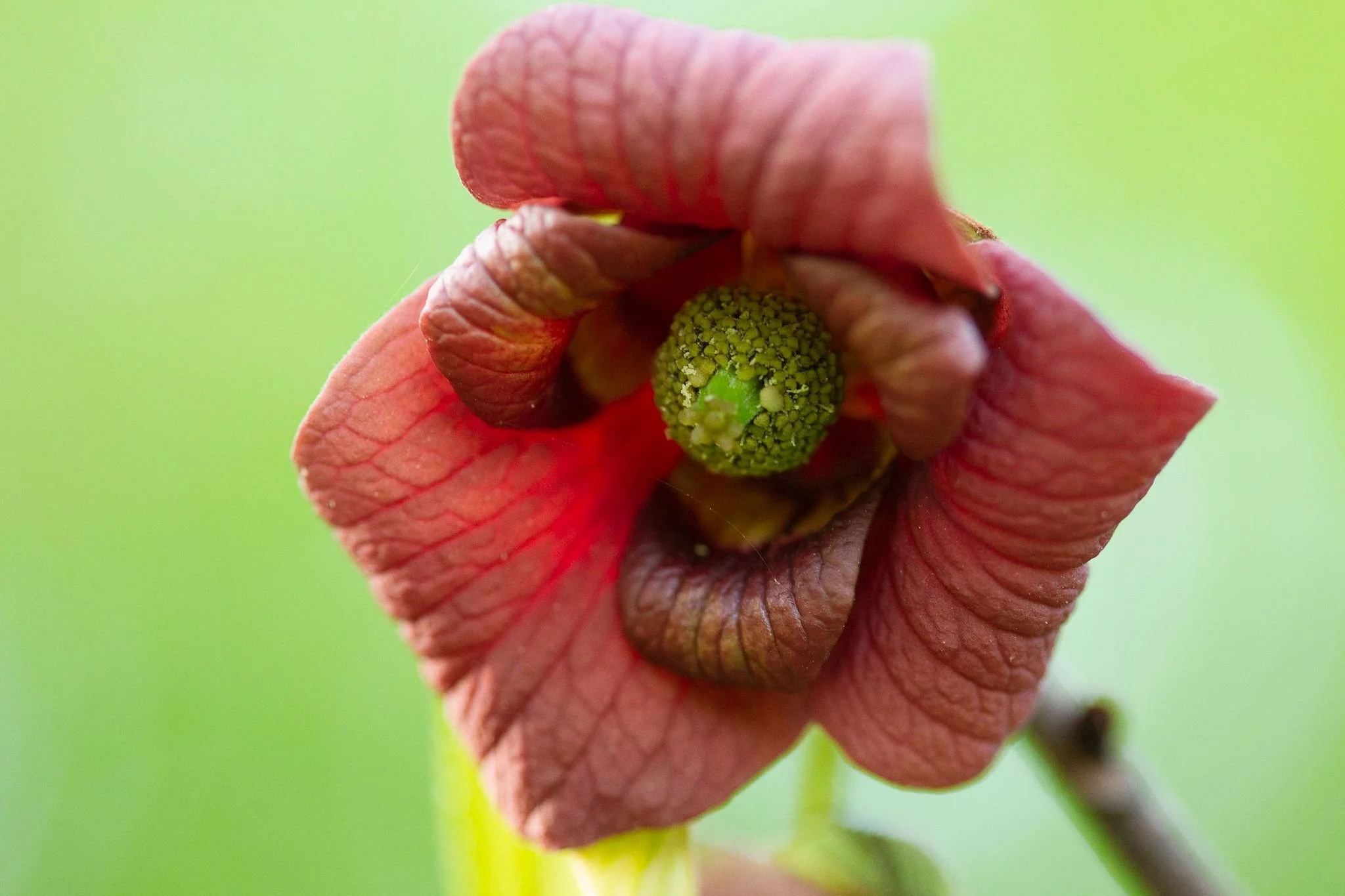
Pawpaw flower close-up
Pawpaw flowers are primarily pollinated by flies and beetles rather than bees. The flowers emit a faint or sometimes absent scent that mimics the smell of decaying meat, a pollination strategy evolved to lure blowflies and carrion beetles. This odor is not strong enough for most people to detect from a distance - in many cases, you won’t smell it unless you are right up close to the bloom. The flowers also mature in a way that makes self-pollination difficult, which brings us to one of the most important things to know before buying a pawpaw.
Don't Buy Just One Pawpaw Tree
If your goal is fruit, this is probably the most important sentence in this article:
Buy at least TWO genetically different pawpaw trees.
Pawpaws generally require cross-pollination. Two different named cultivars work, as do genetically different seedlings. Two trees that are genetically identical will not solve the pollination problem.
I actually like the Oklahoma State recommendation of planting at least two and preferably three different varieties when possible.
Kentucky State recommends about 8 feet between trees in home/orchard plantings. The bigger point is that they should be reasonably close to one another so those flies and beetles can carry pollen between them.
So if you're standing at a nursery thinking,
"I'll just buy one and see how it does…"
don't be surprised if you eventually have a gorgeous tree covered in flowers but very little fruit.
For fruit, pawpaws need friends.
Where Should You Plant Pawpaw Trees?
Pawpaws are interesting because what they want when they're babies isn't necessarily what gives you the most fruit later.
In nature they're understory trees, and young pawpaw seedlings can be very sensitive to strong sun. Kentucky State recommends shading outdoor seedlings during their first year and sometimes their second. Once established, though, trees can grow in full sun, and more sunlight generally means better fruit production.
Their preferred soil is:
Deep and fertile
Moist but well drained
Slightly acidic, roughly pH 5.5–7
Not chronically waterlogged
And don't forget water during establishment. Newly planted pawpaws need reliable moisture, particularly during their first couple of years.
One more thing: those enormous leaves catch wind. A site with some protection from strong winds can be helpful.
Can I Grow a Pawpaw From the Seeds in the Fruit?
You know I was going to ask this.
Because once a gardener cuts open a fruit and sees those enormous glossy seeds, throwing them away seems practically criminal.
Yes, you can grow pawpaws from seed.
But you can't treat them like tomato seeds.
Here's how to start pawpaw seeds
1. Start with fresh seed.
Remove the seeds from a ripe pawpaw and clean the pulp from them.
And here's the BIG rule:
DO NOT LET PAWPAW SEEDS DRY OUT.
Kentucky State found that allowing seeds to dry at room temperature for just three days can drop germination below 20%. Seeds also should not be allowed to freeze.
That means the seeds from the pawpaw I just ate shouldn't sit forgotten on my counter for three weeks while I tell myself I'll get to them tomorrow.
Not that I would ever do such a thing.
Ahem.
2. Give them a cold, moist winter.
Pawpaw seeds have dormancy that must be broken with approximately 70–100 days of cold, moist stratification.
One easy method is putting cleaned seeds in a zip-top bag with a small amount of moist sphagnum moss and refrigerating them at about 32–40°F.
Moist.
Not swimming.
Another option is planting fresh seeds outside in late fall and allowing winter to do the stratification naturally.
3. Plant about 1 inch deep.
After stratification, Kentucky State recommends planting seeds approximately 1 inch deep in a well-aerated growing medium. Warm soil - around 75–85°F - encourages germination.
4. Use a DEEP pot.
This is not the seedling for your cute little 2-inch seed-starting cell.
Pawpaws start developing a substantial taproot very early. KSU recommends tree pots roughly 14–18 inches deep or root-training containers around 10 inches deep.
That deep root is also one reason established pawpaws can be difficult to transplant.
5. Be patient.
The root starts working before you see much happening aboveground. Under good conditions, the seed can germinate within a few weeks, but the shoot may not emerge for around two months.
Do not assume nothing is happening and dump the pot.
That advice may be specifically directed at impatient gardeners like me.
When Will a Pawpaw Grown From Seed Produce Fruit?
This is where seed-grown and purchased grafted trees are very different.
A seedling pawpaw generally takes about 5–8 years to begin bearing fruit, according to Kentucky State's planting guide.
There is another catch.
A seedling is genetically unique. It's not a clone of the pawpaw you just ate.
So even though my pawpaw tasted like delicious banana pudding, a tree grown from one of its seeds may produce fruit that's somewhat different.
That's not necessarily bad.
It's just a surprise package.
Want Fruit Faster? Buy a Grafted Pawpaw
If your main goal is reliable, high-quality fruit, I'd strongly consider purchasing grafted named cultivars.
Grafted trees preserve the characteristics of the parent cultivar, so you know much more about the eventual fruit size, flavor and quality. KSU reports that grafted trees can sometimes begin producing in as few as three years, while seed-grown trees take longer.
That makes my ideal experiment pretty obvious:
Grow these seeds because it's fun AND buy a couple of grafted pawpaws because I'd rather not wait eight years for my next homegrown banana-pudding experience.
Shopping for Pawpaw Trees This Fall? Look for These Things
Fall is a fantastic time to look at your landscape, decide where future trees belong and see what nurseries have available.
But pawpaw gives us a little twist.
Kentucky State's research has found spring transplanting more successful, particularly because pawpaws have fleshy, brittle roots that don't appreciate disturbance. Their recommendations favor transplanting around the time new spring growth begins.
For northern gardeners, Michigan State also generally recommends spring planting for bare-root fruit trees and notes that fall planting young fruit trees carries additional winter risk.
So my fall advice for pawpaws is:
Fall may be the perfect time to PLAN and SHOP for pawpaws even if spring ends up being the better time to put them in the ground. So decide what you want and where you’ll purchase from - and add it to your spring calender.
When you're shopping, ask:
Is this a seedling or a grafted cultivar?
Seedlings cost less but produce unpredictable fruit and generally take longer to bear. Grafted cultivars give you known fruit characteristics.
What cultivar is it?
If you're buying two trees, make sure they're genetically different cultivars.
Was this cultivar selected for a climate similar to mine?
KSU specifically recommends choosing cultivars originating in a climate and latitude similar to where they'll be grown — especially important for northern gardeners.
Is it container-grown?
That's a big plus. KSU notes that container-grown pawpaws may establish more successfully than field-dug trees because their delicate taproots can be damaged during digging.
Is the root system healthy?
Avoid badly root-bound, damaged or stressed plants. With pawpaws, protecting those roots matters.
And don't automatically grab the biggest tree in the nursery.
A healthy smaller pawpaw with an intact root system may establish better than a large specimen that has experienced significant root disturbance.
What About Pawpaw Pests and Diseases?
Here's another reason pawpaws are getting my attention.
They generally have relatively few serious pest problems compared with many traditional fruit trees. Kentucky State notes that pawpaw has few important pests in its native range.
And there's a bonus for gardeners interested in supporting wildlife:
Pawpaw is the host plant for the zebra swallowtail butterfly.
Fruit, native plant, gorgeous foliage AND butterflies?
This tree is making a pretty convincing argument for a spot in an edible landscape.
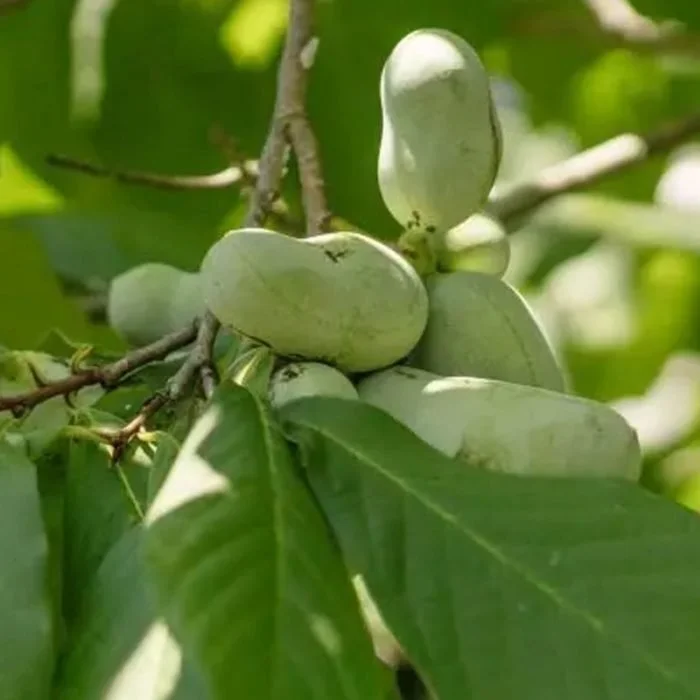
Fruit growing on tree
How Do You Know When a Pawpaw Is Ripe?
Apparently this part matters because the difference between an underripe pawpaw and a perfectly ripe one can change your whole opinion of the fruit.
Ripe pawpaws begin to soften and can be gently pulled from the tree much like a ripe peach. Depending on the cultivar, harvest can run from late summer into early fall.
They also don't have much shelf life. That's one reason this incredibly delicious native fruit isn't piled next to bananas at every grocery store.
Which may also explain why so many of us have reached adulthood without ever trying one.
So…Am I Growing Pawpaws?
After today's taste?
Oh yes.
The only question now is where I'm putting them.
I love the idea of adding another edible perennial to the landscape - especially one that's native to this part of the country, cold-hardy enough for northern gardens and capable of producing fruit that tastes like somebody crossed a banana with pudding.
My immediate experiment is going to be saving these seeds and getting them into cold, moist stratification.
But I'm also going to start looking at grafted cultivars suited to northern climates, because apparently pawpaw trees are yet another thing I didn't know I needed until I tasted the fruit.
And now I need at least two.
Because gardeners never buy just one plant anyway.
Have you tried a pawpaw?
Did it taste like banana pudding to you too?
And if you're already growing pawpaw trees, tell me what cultivar you're growing and what state or growing zone you're in. I'd love to hear what's working for other northern gardeners.
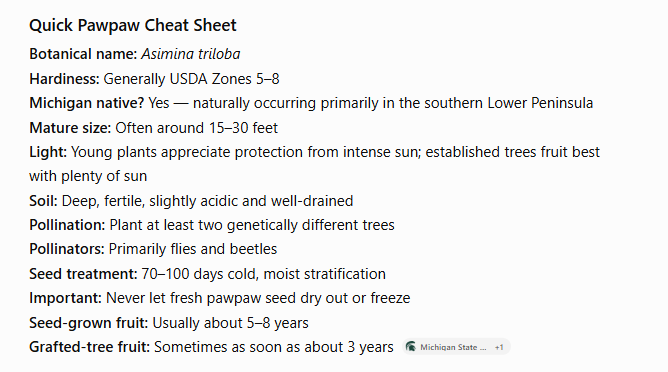
Sources & Further Reading
Kentucky State University Cooperative Extension — Pawpaw Planting Guide, S.C. Jones, R.N. Peterson, T. Turner, K.W. Pomper, and D.R. Layne. Information on USDA zones, soil, sunlight, seed propagation, 70–100 days of cold-moist stratification, taproots, purchasing grafted versus seedling trees, spacing, pollination, and establishment.
Kentucky State University Cooperative Extension — Forest Production of Pawpaw, K.W. Pomper and S.B. Crabtree. Information on site selection, full-sun fruit production, genetically different trees for pollination, growing pawpaw from seed, spring versus fall planting, grafted trees, and early tree care. KSU reports that spring planting has been more successful than fall planting in its Kentucky trials.
Kentucky State University Pawpaw Research Program — Propagation. Additional information on keeping pawpaw seeds moist, refrigerator stratification, planting depth, germination temperatures, and seed dormancy.
Michigan State University Extension — Identifying Trees of Michigan. Michigan-specific information confirming that Asimina triloba is native to Michigan, with its natural range primarily in the southern Lower Peninsula. It also describes the simple leaves, banana-flavored fruit, preferred habitat, and mature size of generally less than 30 feet.
Michigan State University Department of Horticulture — Guidelines for Planting Fruit Trees, Dr. Ron Perry. Used for northern/Upper Midwest tree-planting guidance. MSU recommends planting bare-root fruit trees in spring and notes that fall planting exposes young trees to additional winter risks.
Mississippi State University Extension — Pawpaw Tree—a Mississippi Native. Information on pawpaw flowers and pollinators, young-tree sun protection, soil and water needs, cross-pollination, and the difference in bearing age between seedlings and grafted trees.