Growing Carrots the Lazy Way
From Winter Seed Tape to the Pantry
Carrots seem like they should be one of the easiest vegetables to grow.
They're tiny seeds. You sprinkle them in the garden, cover them with a little soil, water them and wait for carrots.
Except anyone who has tried growing carrots knows there's a little more to it than that.
Getting them to germinate can be frustrating. The seeds are ridiculously tiny. Once they finally come up, they're often too close together and need to be thinned. Then you wait for months, pull one out and discover something that looks less like a carrot and more like it grew up trying to navigate an obstacle course.
I've grown plenty of those. 😂
Over the years, I've found some ways to make growing carrots work better for me – and, more importantly, require less unnecessary work.
Because I am The Lazy Northern Gardener, after all.
My Carrot Season Actually Starts in Winter
One of my favorite times to prepare for carrot season is when I can't garden at all.
Winter.
That's when I can sit inside and make homemade carrot seed tape.
Carrot seeds are incredibly small, which makes individually spacing them in the garden difficult. The usual method is to sow more seeds than you need and then come back later and thin the seedlings.
There's nothing wrong with that method.
I just don't particularly like creating a second job for myself.
I'd rather spend a little time during the winter making carrot tape with the seeds already spaced where I want them. Then, when it's time to plant, the tape goes into the garden.
Plant once instead of plant now and thin later.
That's my kind of gardening.
In fact, I created my No Thin Carrot Tape instructions and videos because this has worked so well for me.
This Year I Didn't Follow My Own Advice
Of course, knowing a better way and actually doing it are two different things. 😂
This year I didn't make my carrot tape.
Instead, I sowed the carrot seeds directly between my rows of onions.
Then I didn't go back and thin them.
Part of my brain said:
Oh good. I don't have to thin carrots.
The other part said:
Yeah...but you're probably going to have really small carrots.
Crowded carrots compete for water, nutrients and, most importantly, physical growing space. Proper spacing gives those roots room to develop.
Fortunately, my Short 'n Sweet carrots still did surprisingly well.
But the experience reminded me exactly why I like making carrot tape in the first place.
Why I Grow Carrots Between My Onions
I frequently grow carrots between rows of onions.
They make good garden companions in my beds, and I like using the available space rather than giving every vegetable its own isolated section of the garden.
You'll also hear gardeners talk about using strongly scented plants such as onions to help confuse certain insects around carrots.
There's something rather funny about that in my garden, though.
Because I'm actually quite happy when one particular insect finds my carrots.
Sometimes a Caterpillar Is Part of the Harvest
Carrot foliage is in the same plant family as parsley, dill and fennel – plants used by eastern black swallowtail caterpillars.
That means every once in a while, while I'm checking my carrots, I find a swallowtail egg or caterpillar.
I recently pulled one rather unimpressive little carrot.
Normally you might look at that tiny carrot and think:
Well, THAT wasn't worth growing.
Except there was a swallowtail caterpillar on the foliage.
I got to raise the caterpillar.
Suddenly that little carrot didn't seem disappointing at all.
Sometimes the butterfly is part of the harvest. 🦋
That's one of the things gardening has taught me. Success isn't always measured by how many pounds of vegetables come out of a bed.
Have You Ever Seen an ACTUAL Baby Carrot?
Speaking of tiny carrots, have you ever seen a real baby carrot?
Not one of the smooth little carrots in the bags at the grocery store.
An actual immature carrot.
They're adorable.
The familiar grocery-store “baby carrots” are generally baby-cut carrots. They're made by taking larger carrots and cutting, peeling and shaping them into those little uniform pieces. The idea originally provided a way to make use of broken or misshapen carrots that weren't very marketable.
A genuinely young carrot looks quite different.
I had one next to my hand during this year's harvest that made the grocery-store version look enormous.
Apparently the carrot industry doesn't like wasting ugly carrots either.
Now THAT is a philosophy I can get behind. 😂
The Biggest Carrot Problem: Getting the Things to Germinate
Before you can worry about harvesting carrots, you have to convince them to come up.
This is where a lot of new gardeners struggle.
Carrot seeds need consistent moisture while they're germinating, and because they're planted shallowly, that top layer of soil can dry quickly.
When I'm direct sowing, I wet the soil first, sow the seeds, cover them lightly with soil and water carefully.
Then I may lay a piece of cardboard or wood over the row and weigh it down.
The cover helps keep that upper layer of soil from drying out so quickly.
But there's an important second step:
Check underneath it.
Once those little seedlings begin emerging, the cover needs to come off so they can get sunlight.
And yes, carrots can seem like they take approximately forever to germinate.
Patience is part of growing them.
Why Did My Carrot Grow Like THAT?
Then there's the other carrot surprise.
You pull one up expecting a beautiful long carrot and get a twisted, forked, crooked little creature.
Usually the carrot was trying to tell you something about its growing conditions.
Carrots grow best when their roots can move easily through loose soil. Compacted soil, rocks, sticks, old roots and other obstructions can interfere with that growth. A bed that's too shallow can also limit longer varieties.
And spacing matters.
If too many carrots are growing together, they're competing with one another and simply don't have enough room to reach their potential size.
This is another reason I prefer getting the spacing right when I plant instead of fixing it later.
How Do I Know When My Carrots Are Ready?
One of my favorite ways doesn't require pulling one out just to check.
I use my fingertip to gently move a little soil away from the top of the carrot and feel around its shoulders.
If the carrot is about the diameter I want, I'll pull it.
If it's still tiny, I cover it back up and give it more time.
I also look at the foliage near ground level. When those stems have become substantial and thick, that's another clue that there's probably a decent carrot underneath.
It's not foolproof, but it's better than playing carrot roulette every time I walk through the garden.
And Then There's How I Actually Like to Eat Carrots
Here's where I may lose some of you:
I don't like crunchy carrots.
There. I said it.
I want my carrots soft.
But boiled carrots?
No.
Microwaved carrots?
Also no.
Soft because they've been roasted until they're tender and delicious? Absolutely.
My husband will sometimes put carrots in the smoker with meat, and I love them that way. They become tender without heating up my kitchen on a hot summer day, and they pick up that wonderful smoky flavor.
We can grill them, too.
For grilling, I like cutting the carrots into relatively thin strips and cooking them with butter until they're nice and soft while picking up that grilled flavor.
That's a carrot I want to eat.
Preserving the Harvest – Dehydrating Carrots
Of course, I can't eat an entire carrot harvest at once.
This year I'm dehydrating part of it for winter.
I washed the carrots, blanched them and then cut them according to how I'm likely to use them later.
My Short 'n Sweet carrots became rings or discs.
The smaller carrots were cut into chunks that I can toss into:
• Pot pies
• Casseroles
• Soups
• Stews
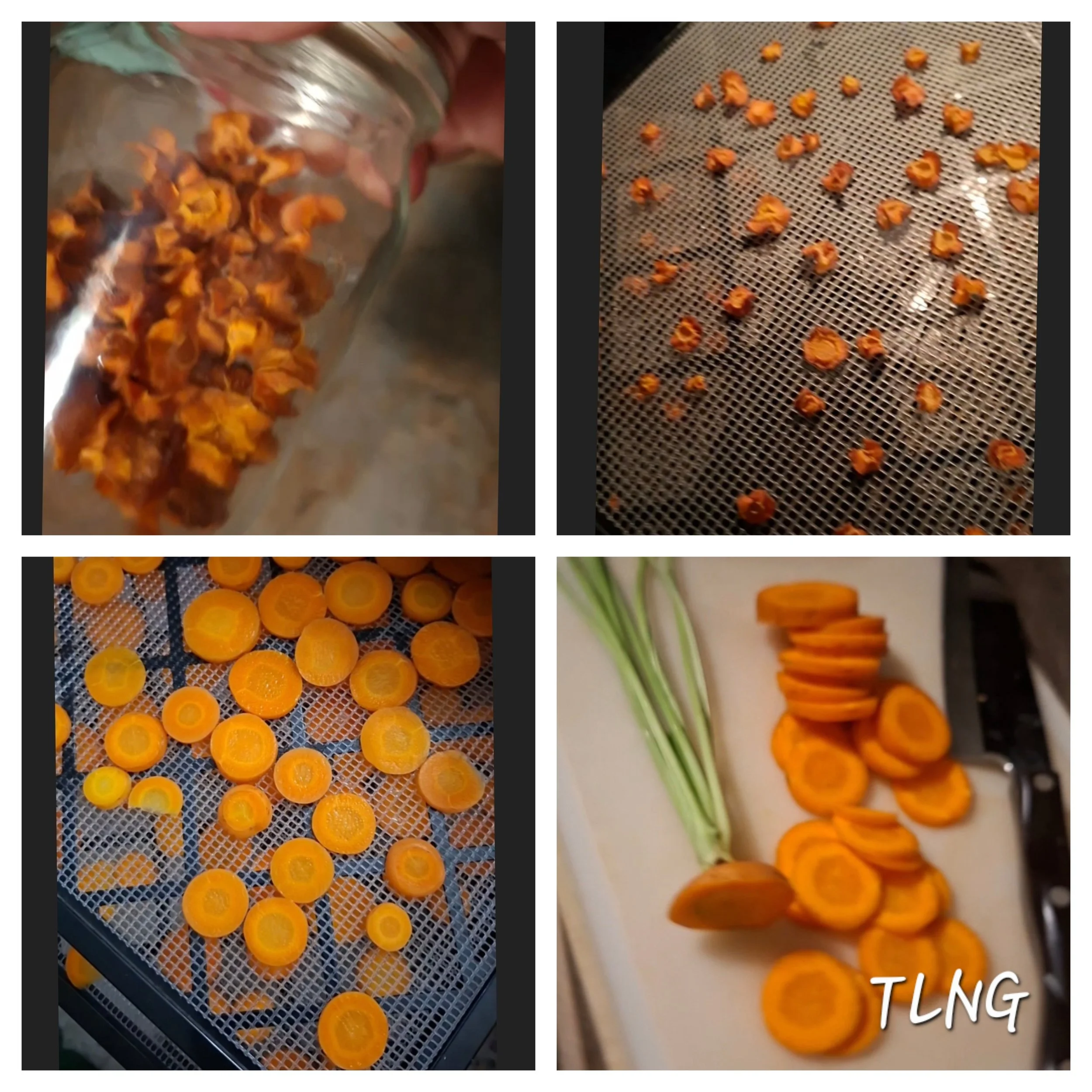
Top - end results - easy storage for long periods. Bottom - huge carrot discs.
That's also how I'll label the jars.
I find that much more useful than simply writing CARROTS on everything.
I'm essentially doing some of the meal preparation now so Future Tammy doesn't have to figure it out later.
After blanching, I cool the carrots promptly, drain them well and put them into the dehydrator at about 125°F until they're thoroughly dry.
I also try to keep similarly sized pieces together. Smaller pieces may finish before larger ones, so separating them lets me remove what's finished without continuing to dry everything just because one tray isn't done.
I Don't Put Them Straight Into the Pantry
When the carrots are finished, they'll go into Mason jars – but they won't immediately join the rest of my preserved food.
First I condition them.
The jars sit on my counter right near the coffee pot.
That's intentional.
If I put them somewhere out of sight, I'm much more likely to forget about them.
For about a week, I pick up the jars every day, give them a little shake, inspect them for any sign of condensation or moisture and flip them to the other end.
This gives remaining moisture among the pieces a chance to equalize and gives me an opportunity to catch food that wasn't completely dry before putting it into long-term storage.
If condensation appears, that's a sign the food needs additional drying.
Once everything remains properly dry, it can move into the pantry.
Even My Old Canning Lids Get Another Job
I also save used flat canning lids.
I do not reuse them for canning, because I can't rely on a previously used lid to create another safe canning seal.
But dehydrated food is different.
Clean, undamaged used lids can have another life on my jars of dry goods.
When I empty something like a jar of stewed tomatoes, I wash and thoroughly dry the lid and put it into a drawer.
Later, when I need one for dehydrated food, I remove the old permanent-marker label. One little trick I've found is scribbling over the permanent marker with a dry-erase marker, letting it sit briefly and wiping it away.
Then I can write the new contents on the lid.
Reuse before replace.
Yes, My Pantry Is Alphabetized
Once those carrots pass their conditioning period, they'll move into my canning and preservation pantry.
Which is alphabetized.
Of course it is. 😂
I spent years working with medical records. Apparently some habits follow you home.
So things progress alphabetically across my pantry:
Carrots...
Peppers...
Squash...
Tomatoes...
And eventually zucchini.
It doesn't matter whether something ends up on the top or bottom shelf. I know approximately where to look because everything has a system.
And systems save time. Click to see this alpha way.
Don't Forget Next Year's Carrots
The carrot story doesn't necessarily end at harvest, either.
Sometimes I'll allow a few carrots to continue through their life cycle so I can eventually collect seed.
Carrot seeds are incredibly tiny, but a plant that successfully flowers and produces seed can give you a LOT of them.
Free seeds for another garden?
Yes, please.
Just remember that carrots are biennials. They normally produce their root during the first growing season and flower and produce seed after experiencing winter and entering their second year. Depending on your climate and how you're growing them, getting a carrot all the way through that cycle may require some planning.
That's My Kind of Carrot Gardening
There's a theme running through all of this.
I don't want to create unnecessary jobs for myself.
If I can make carrot tape during winter when I can't be outside gardening anyway, I don't have to spend my precious spring garden time thinning seedlings.
If I can grow carrots between onions, I'm using my garden space efficiently.
If a small carrot feeds a swallowtail caterpillar, I don't necessarily consider it a loss.
If I can feel the shoulders instead of pulling carrots prematurely, I will.
If we're already running the smoker, my carrots can cook out there instead of heating up the kitchen.
If I'm dehydrating them, I'll cut and label them according to the meals they'll eventually become.
And if a few plants can eventually provide seed for another crop, I'll take that, too.
That's what being a Lazy Northern Gardener means to me.
It isn't about doing nothing.
It's about asking:
Can I do this once instead of twice?
Can nature do some of the work for me?
Can I use what I already have?
Can I make today's work make next season easier?
That's how I grow carrots.
And, really, that's how I grow gardeners. 🌱
Want to Skip Thinning Your Carrots?
If tiny carrot seeds and thinning seedlings are the parts of carrot growing you dread, I've put together my No Thin Carrot Tape instructions along with videos showing you how I do it.
You can make your carrot tape during the winter and have it ready when planting season arrives.
Find No Thin Carrot Tape in my shop here: Store 2 — The Lazy Northern Gardener
I Grow Gardeners. 🌱
Learn. Grow. And garden a little lazier.