Are There Really More Hornworms This Year - Or Are More Gardeners Finding Them?
Sometimes my gardening questions don't start with research.
They start while I'm outside on the homestead doing chores, looking at plants, checking on animals or scrolling through gardening posts later and thinking:
Huh. Why am I seeing so much of THAT this year?
Lately, it's hornworms.
I'm seeing post after post from gardeners holding enormous green caterpillars and asking:
"What is this thing?"
If you've gardened for a long time, you probably recognize it immediately.
Hornworm.
But seeing so many of these identification posts got me wondering:
Are there actually more hornworms this year?
Or are there simply more inexperienced gardeners encountering hornworms and asking about them online?
Those are two very different things.
Correlation Isn't Causation - But It's Okay to Be Curious
Seeing dozens of hornworm posts doesn't prove that the hornworm population has exploded. Social media is definitely not a scientific insect survey.
But observations are often where good questions begin. So I started digging, and what I found made the question even more interesting.
First: Hornworms ARE Active in Michigan Right Now
Michigan State University Extension specifically mentioned tomato and tobacco hornworms in its July 22, 2026 Michigan Vegetable Crop Report.
They're among Michigan's largest caterpillar pests of tomatoes, but here's something many gardeners don't realize:
Hornworms don't only eat tomatoes.
· Peppers
· Potatoes
· Eggplants
All of these crops belong to the nightshade family. MSU warns that hornworms can quickly defoliate plants and may even feed on green fruit.
That explains why I've been talking about them recently. But it still doesn't answer my question: Are there MORE of them this year?
At this point, I haven't found university research documenting a widespread 2026 hornworm population explosion or identifying a specific cause. So I'm not going to claim there is one. But there are several possibilities worth thinking about.
Maybe We're Simply Seeing More Hornworms
Hornworm populations can fluctuate. The caterpillars eventually become sphinx or hawk moths. Females lay their eggs on tomatoes and other plants in the nightshade family.
Hornworms eventually drop from the plant and pupate in the soil, where a later generation can overwinter. That means weather, winter survival, available host plants, predators and farming or gardening practices can all influence how many survive.
Tillage can matter too. Utah State University Extension reports that post-harvest tillage can expose hornworm pupae to winter conditions and can cause very high mortality.
That made me wonder about another gardening trend: as more of us adopt reduced-tillage and no-till gardening methods, could more pupae survive?
Maybe.
But "maybe" is important. A biologically plausible explanation isn't the same thing as evidence that it caused what we're seeing in 2026.
What About Organic Gardening and Farming?
This was another question that occurred to me. If fewer broad-spectrum pesticides are being used, could more adult hawk moths survive to lay eggs? Could more weeds and wild nightshade-family plants provide additional food sources for hornworms?
Again - interesting questions.
Hornworms do use other members of the nightshade family as hosts, including some weeds. But there's another side to this.
Reducing broad-spectrum insecticide use can also protect the insects that kill hornworms.
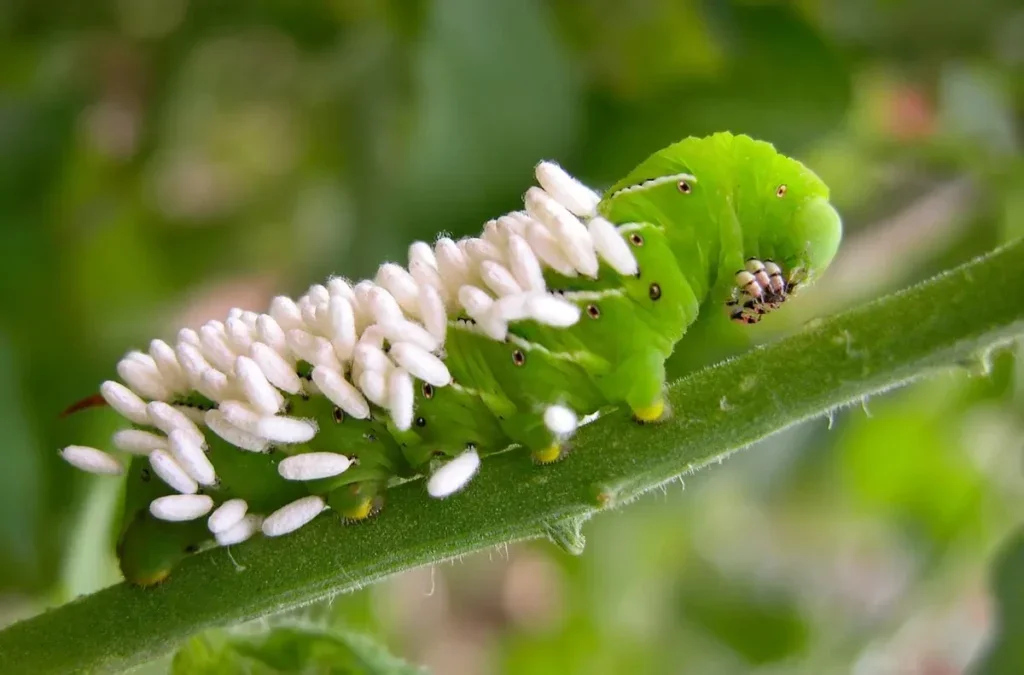
Hornworms have plenty of natural enemies, including parasitoid wasps. You've probably seen photographs of a hornworm covered with what look like little grains of white rice. Those aren't hornworm eggs. They're cocoons from beneficial parasitoid wasps. See photo below.
If you find one of those hornworms, leave it alone! Those wasps are doing pest control for you.
So an ecosystem with fewer broad-spectrum pesticides could potentially support more moths - and more of the beneficial insects that keep their caterpillars under control.
Nature is rarely as simple as: No pesticide = more hornworms.
But Then I Thought of Something Else
What if what I'm seeing online isn't primarily an insect-population story?
What if it's a gardener story?
That possibility made me laugh.
Imagine two gardeners walking outside and finding a four-inch green caterpillar eating a pepper plant.
The experienced gardener:
"Oh. Hornworm." Pick. Squish. Feed to chicken. Continue watering.
The brand-new gardener:
"WHAT IN THE JURASSIC PARK IS THIS THING?!" Take picture. Post to Facebook. "HELP! Does anyone know what this is?!"
And suddenly my gardening feed contains 37 pictures of hornworms.
There Are Some Interesting Numbers Behind That Idea
The 2026 National Gardening Survey found that approximately 4.5 million U.S. households left gardening during 2025. So it would be incorrect to say that the overall gardening population is simply exploding.
But the gardeners who stayed are highly engaged, and another 2026 gardening study found particularly strong engagement among younger gardeners.
In Axiom's 2026 Gardening Outlook Study, Millennials and Gen Z were especially likely to say they expected to spend more time gardening.
There's another statistic I find especially interesting: 61% of gardeners say they would garden more if they knew more about gardening. Video and internet searching have also become major ways gardeners learn.
Put that together with younger gardeners who grew up taking a photo and asking an online community to identify something, and suddenly all those hornworm identification posts make a lot more sense.
Maybe More Posts Don't Mean More Hornworms
There could genuinely be more hornworms in some areas this year. There could also be more younger or inexperienced vegetable gardeners encountering them. And those gardeners may be far more likely to photograph an unfamiliar insect and post it online.
More hornworms + more online gardeners + more identification posts = what looks like a hornworm explosion.
But social-media frequency isn't the same as insect-population data.
And Hornworms Are Perfect Social-Media Bugs
Let's face it.
Nobody runs into the house yelling: "HONEY! GET YOUR PHONE! THERE'S AN APHID!"
Hornworms are different. They're huge. They're bright green. They have a horn sticking out of their rear end. They can be almost impossible to see until suddenly you see one - and then you wonder how you ever missed a caterpillar the size of your finger.
They're practically designed to generate: "WHAT IS THIS?!" posts.
This Is Why I Still Ask Questions
After decades of gardening, I still don't assume I know everything that's happening outside. Actually, the longer I garden, the more questions I seem to have.
Why are there more of these? Why aren't I seeing as many of those? Why did this plant thrive this year when it struggled last year? Did the weather cause it? Did something I changed cause it? Is everybody experiencing this - or am I just noticing it now?
Sometimes research gives me an answer. Sometimes it gives me five more questions. And sometimes the answer is: We don't know yet.
That's okay.
There's a difference between making an unsupported claim and asking a reasonable question based on something you've observed.
Correlation isn't causation. But curiosity is how we learn.
And that's one of my favorite things about gardening. No matter how long you've been doing it, the garden will always give you something new to wonder about.
What About Your Garden?
Are you seeing more hornworms than usual this year?
And I'm especially curious: Is this your first or second year growing vegetables - and was 2026 the first time you've ever seen a hornworm?
Tell me where you garden and what you're seeing. Maybe our completely unscientific gardener survey will give us another question worth investigating.
Bonuses
How Commercial Growers Deal With Squash Vine Borers
Squash Vine Borer Survival Guide
Keep Learning - Related Resources
If you're still figuring out how many tomatoes, peppers and other vegetables you should grow, read my How Many Should I Plant? guide next.
New to gardening? My free garden resources can help you plan your garden and grow with more confidence.
Have a "What in the world is THIS?" garden problem? Garden mentoring gives you a place to ask questions, send photos and get help figuring out what's happening.
Need more personalized help with pests, diseases, soil problems or your garden as a whole?
Sources
Michigan State University Extension - Michigan Vegetable Crop Report, July 22, 2026
National Gardening Association / Garden Research - 2026 National Gardening Survey
Axiom Marketing - 2026 Gardening Outlook Study