Where to collect samples, where to send them, what testing costs and how to understand your results.
By The Lazy Northern Gardener | November 27, 2026
How well do you really know your garden soil?
As gardeners, we often test our soil to determine whether we need more nutrients, organic matter or adjustments to our soil's pH. But how many of us have ever tested our soil for lead?
Following my article, How to Protect Your Garden Soil From Lead Contamination, I wanted to provide gardeners with a practical guide to testing their own properties.
If you live near an industrial facility, along a busy road, in an older neighborhood, on former agricultural land or simply want to establish a baseline for your property, soil testing can help you make more informed gardening decisions. You don't necessarily need to hire someone to collect routine garden soil samples. You can often collect them yourself and mail them to a qualified laboratory.
Here's how to get started.
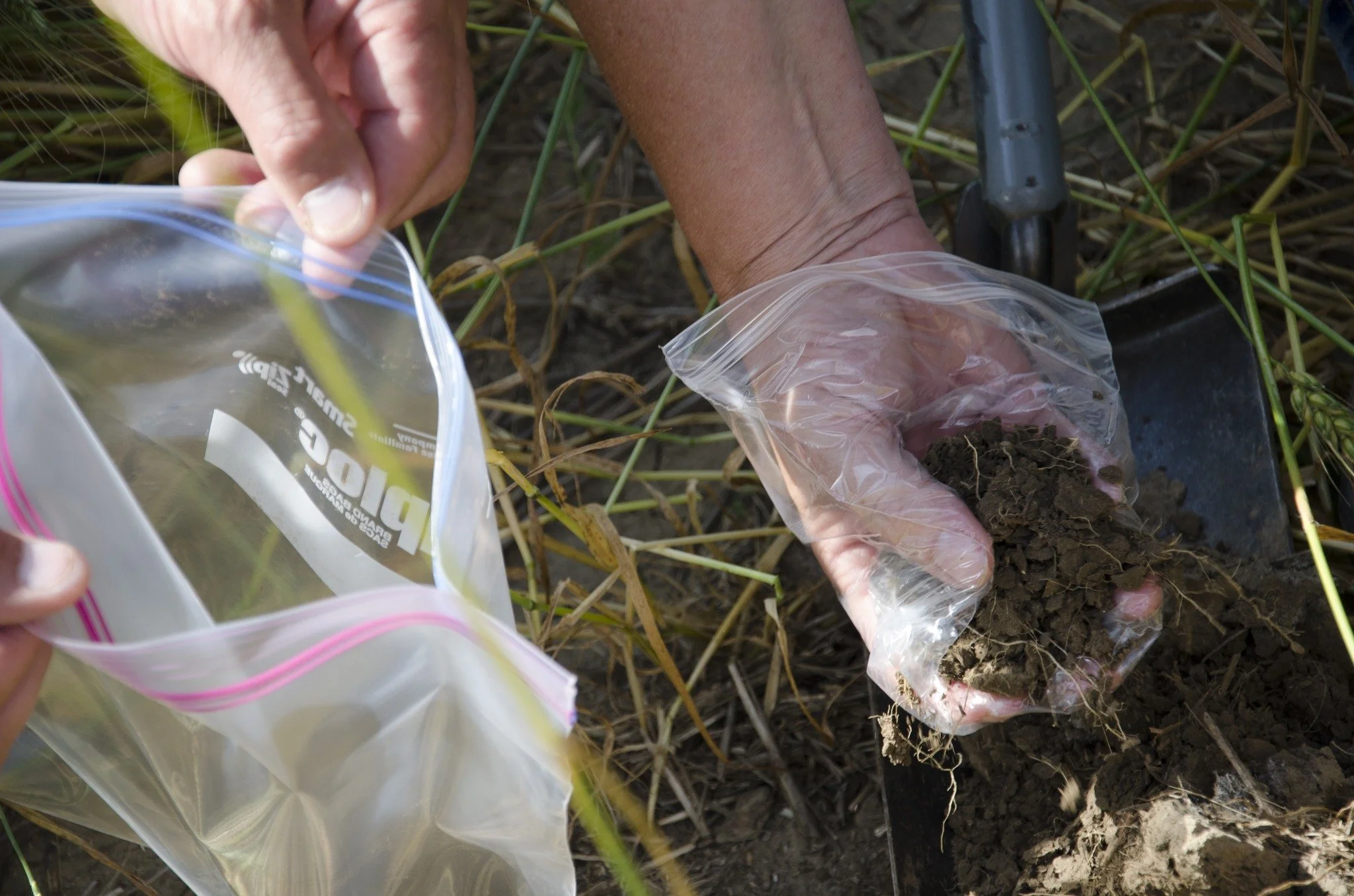
Why Should Gardeners Test Their Soil for Lead?
Lead can be present in soil for decades without any obvious signs of contamination. Your plants may look perfectly healthy, your earthworms may be thriving and your garden may be producing beautiful vegetables.
Unfortunately, none of those things tells you how much lead is present.
Potential sources of soil lead include:
Old lead-based paint.
Historical emissions from leaded gasoline.
Industrial facilities and manufacturing operations.
Demolition and construction debris.
Former orchards treated with lead-based pesticides.
Contaminated imported topsoil.
Old burn piles.
Former shooting ranges.
Contaminated stormwater runoff.
Airborne environmental contamination.
Naturally occurring lead in the soil.
Even if you don't currently suspect contamination, establishing baseline lead levels can provide valuable information for future reference.
1. Make Sure You Order the Right Soil Test
Not all soil tests are the same.
A standard garden soil test typically measures things such as:
Nitrogen or related fertility indicators.
Phosphorus.
Potassium.
Soil pH.
Organic matter.
Other plant nutrients.
These tests help us understand how to grow healthier plants, but they don't necessarily tell us whether our soil contains potentially harmful contaminants.
When contacting a laboratory, specifically ask for total lead concentration in soil.
Some laboratories offer a lead-only test, while others offer a comprehensive heavy metal analysis that may include arsenic, cadmium, mercury and other contaminants.
Ask the laboratory whether its testing method is appropriate for evaluating residential garden soil and whether it provides total or estimated total lead concentrations.
Important information for Michigan gardeners
The standard Michigan State University Extension home lawn and garden soil test does not test for lead, heavy metals, pesticides or other environmental contaminants.
However, MSU Extension maintains a list of laboratories that provide environmental contaminant testing.
MSU Extension: Testing for Contaminants in Soil, Water and Plants
You can also contact the MSU Extension Lawn and Garden Hotline at 1-888-678-3464.
2. Decide Which Areas of Your Property to Test
One mistake homeowners can make is collecting soil from all over their property and mixing it into one sample.
Different areas of your property may have very different lead concentrations.
For example, soil beneath a downspout may contain contaminants washed from your roof, while soil inside a protected greenhouse may have considerably lower concentrations.
Combining those two samples could conceal a problem.
Consider testing the following areas separately.
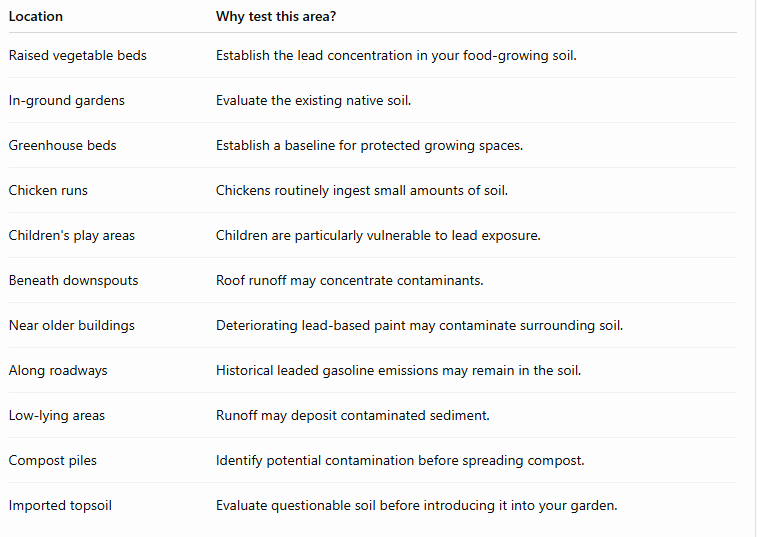
You don't necessarily need to test every location at once. Start with the areas where you grow food, where children play and where you have the greatest reason to suspect contamination.
3. Gather Your Soil Sampling Supplies
You probably already have most of the supplies you need.
A clean stainless steel garden trowel or soil sampling tool.
A clean plastic bucket.
Disposable gloves.
Sealable plastic bags or laboratory-provided containers.
A permanent marker.
A ruler or measuring tape.
A notebook or property map.
Avoid using old painted containers, galvanized buckets or tools that could introduce contaminants into your samples.
Contact your chosen laboratory before collecting samples. It may have specific requirements regarding sampling depth, sample size, preparation and packaging.
4. Collect Your Soil Samples
For routine garden soil testing, you will generally want to collect several smaller samples from a single growing area.
Step 1: Identify your sampling area
Choose one garden bed or another area of your property that you want to evaluate.
Step 2: Remove loose surface debris
For routine root-zone testing, gently move aside loose leaves, mulch and other surface material to expose the soil.
If you are investigating recent airborne contamination, ask your laboratory how to handle surface debris before removing it.
Step 3: Collect several small samples
Collect approximately five to ten small soil samples from different locations within the same growing area, unless your laboratory instructs otherwise.
For established vegetable gardens, sampling the upper six inches of soil is a common approach to evaluating the root zone.
Keep your sampling depth consistent.
Step 4: Combine the samples
Place the smaller samples from that particular growing area into a clean plastic bucket and mix them thoroughly.
This creates what is called a composite sample, which provides an estimate of the average lead concentration within that area.
Do not combine areas with different contamination risks.
Step 5: Prepare your sample for mailing
Transfer the amount of soil requested by the laboratory into the appropriate sample container.
Some laboratories request approximately one pint of soil, while others require less.
Follow the laboratory's instructions regarding whether the soil should be air-dried before mailing.
Step 6: Label your sample
Include the following information:
Your name.
Sample identification number.
Sampling location.
Sampling date.
Sampling depth.
Whether the soil was protected or exposed.
Any known or suspected sources of contamination.
Step 7: Clean your equipment
Clean your tools and bucket between sampling locations to avoid transferring soil from one area to another.
Repeat the process for each area you want tested.
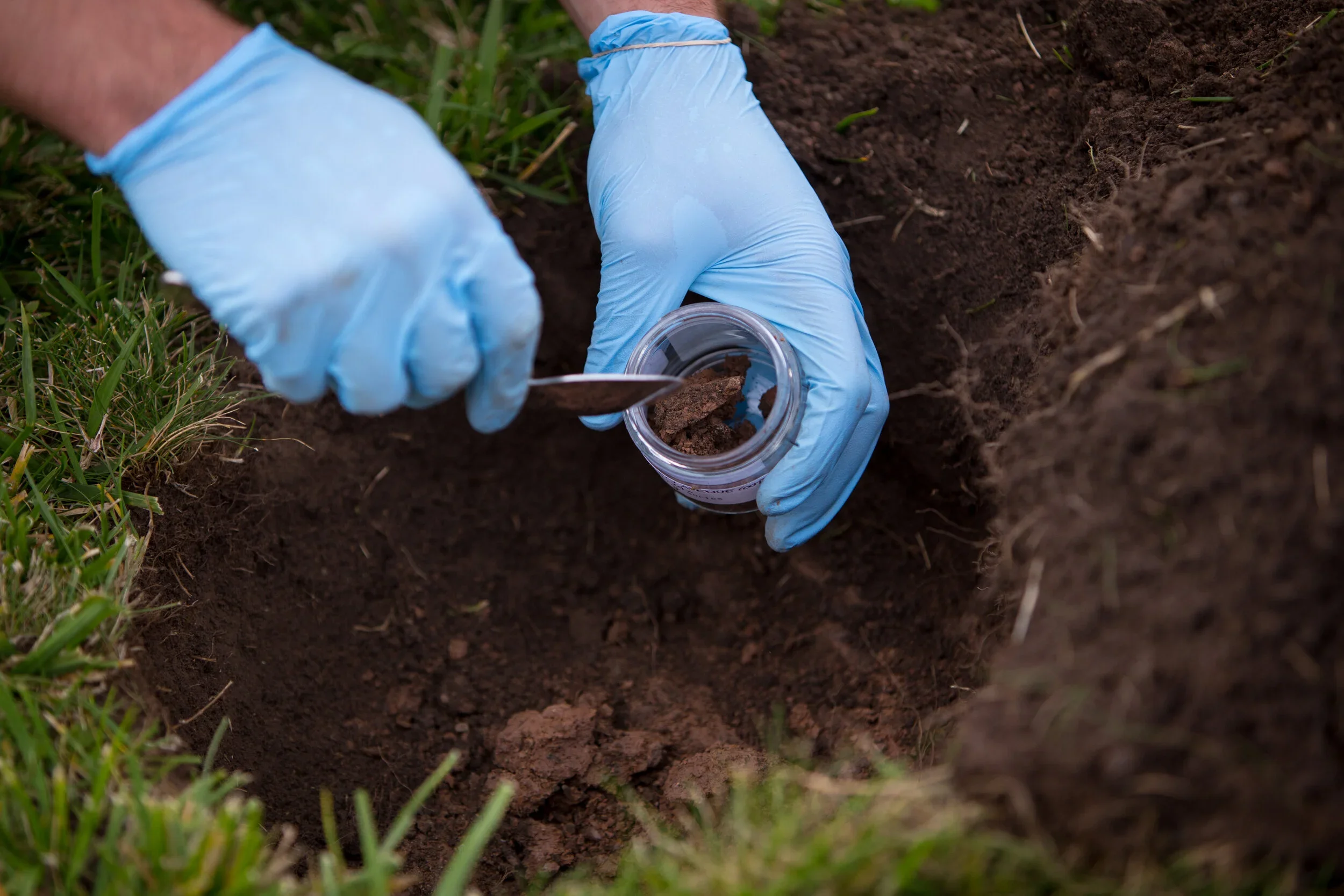
5. Sampling After a Potential Airborne Contamination Event
If you are specifically concerned about recent airborne lead deposition, your sampling method may need to be different from routine garden soil testing.
Recently deposited lead particles may initially be concentrated at or near the soil's surface.
If you collect six inches of soil and mix everything together, you may dilute that surface contamination and make it more difficult to detect.
In this situation, contact an environmental testing laboratory or your local health department for guidance.
They may recommend separately testing:
The uppermost layer of exposed soil.
Deeper soil within the plant root zone.
Surface mulch or leaf litter.
Soil beneath protective garden covers.
Soil inside a greenhouse.
Sediment collected beneath downspouts.
Outdoor surface dust.
Avoid digging, tilling or adding new soil before collecting samples intended to investigate recent deposition.
These activities could redistribute the very material you are trying to measure.
If authorities have issued a contamination warning, follow their instructions before entering or disturbing the affected area.
6. Where Can You Send Soil Samples for Lead Testing?
Several universities and environmental laboratories offer soil lead testing.
You don't necessarily need to use a laboratory located in your own state, provided the laboratory accepts samples from your location.
University of Maine — Analytical Laboratory and Maine Soil Testing Service
The University of Maine offers soil testing for lead and other trace elements.
This is one option worth investigating if you are interested in testing multiple locations on your property.
University of Maine Soil Testing Laboratory
University of Minnesota — Soil Testing Laboratory
The University of Minnesota offers a lead-only soil test through its lawn and garden testing program.
Its published price was $23 per sample when I researched this article.
University of Minnesota Lawn and Garden Soil Testing
Penn State — Agricultural Analytical Services Laboratory
Penn State offers environmental soil testing, including analysis for:
Cadmium.
Copper.
Lead.
Nickel.
Chromium.
Zinc.
This may be a better option if you are concerned about several heavy metals rather than lead alone.
Penn State Environmental Soil Testing
Colorado State University — Soil, Water and Plant Diagnostics Laboratory
Colorado State University offers individual heavy metal testing as well as broader environmental testing packages.
Its published price for individual heavy metal analysis, including extraction, was $45 per sample when I researched this article.
Colorado State University Testing Prices
Michigan Department of Health and Human Services
Michigan residents can contact MDHHS for information about environmental lead testing, qualified laboratories and interpreting soil lead results.
EPA National Lead Laboratory Accreditation Program
The EPA maintains information about recognized laboratories that perform environmental lead testing.
An accredited environmental laboratory may be especially important if you need results for a formal contamination investigation, property transaction or remediation project.
EPA National Lead Laboratory Accreditation Program
SoilSHOP — Free Community Soil Screening
The Agency for Toxic Substances and Disease Registry supports community soil screening events through its SoilSHOP program.
At participating events, residents may be able to bring soil samples for free lead screening.
These events can be an affordable way to begin learning about your soil, although additional laboratory testing may be necessary.
7. How Much Does Soil Lead Testing Cost?
Testing prices depend on the laboratory, analytical method and number of contaminants being evaluated.
Below are examples of testing options available when this article was researched in November 2026.
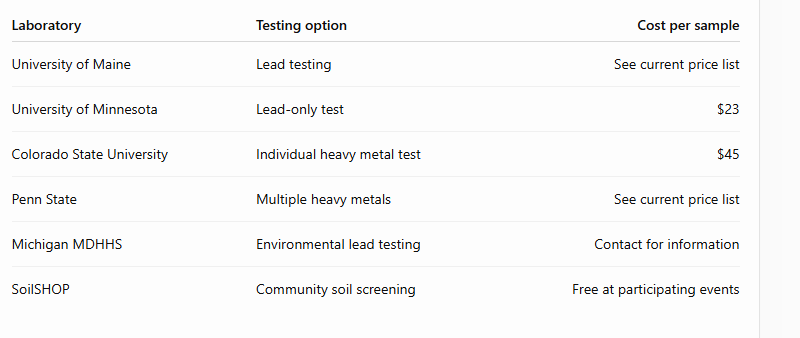
Shipping and additional laboratory fees may apply.
If you are working with a limited budget, prioritize your vegetable garden, children's play areas and other locations with the greatest potential for exposure.
Before ordering a test, confirm:
Whether the laboratory accepts residential samples from your state.
The current cost.
How much soil is required.
The sampling depth.
Whether the test measures total lead.
The laboratory's reporting limit.
Whether interpretation of results is included.
How long it takes to receive results.
Testing doesn't have to be prohibitively expensive, especially if you begin with just a few carefully selected locations.
8. Understanding Your Soil Lead Test Results
Soil lead concentrations are commonly reported in parts per million (ppm) or milligrams per kilogram (mg/kg).
For soil lead concentration, these units are numerically equivalent.
For example, a result of 50 mg/kg is the same as 50 ppm.
However, interpreting those numbers requires more than simply deciding whether your soil passed or failed a test.
The following table provides a conservative gardening approach informed by EPA and university Extension guidance.
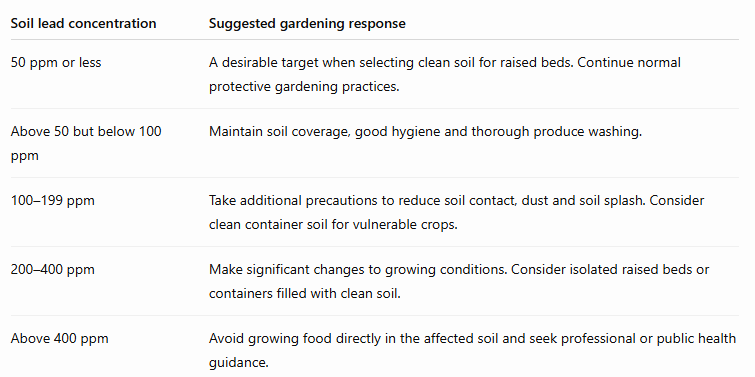
These are practical gardening recommendations, not universal legal thresholds or guarantees of safety.
Children, pregnant women and households with other potential sources of lead exposure may require more conservative precautions.
The EPA recommends using clean soil containing no more than 50 ppm of lead when constructing raised garden beds at contaminated sites.
EPA: Healthy Gardening Practices to Reduce Exposure to Lead-Contaminated Soil
What does nondetect mean?
If your laboratory report says lead was not detected, look for the laboratory's detection or reporting limit.
A nondetect result generally means the amount was below the applicable analytical limit. It does not necessarily mean there was absolutely no lead in the sample.
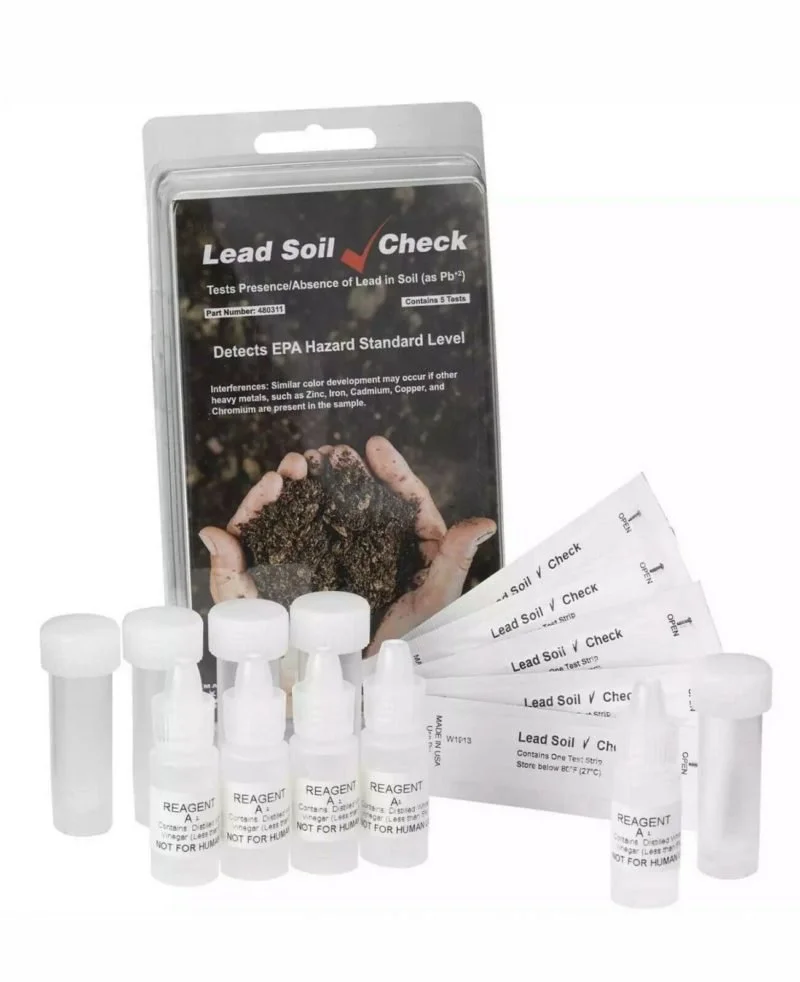
This is another reason to use an appropriate laboratory rather than relying on a simple color-changing home test.
9. Can You Test Garden Soil for Lead at Home?
You may have seen inexpensive lead testing swabs advertised online or sold at hardware stores.
Many of these products are designed primarily to detect lead in paint or on specific surfaces.
They are not a reliable substitute for quantitative laboratory soil testing.
A typical lead swab cannot reliably tell you:
How many parts per million of lead are in your soil.
Whether your soil exceeds recommended gardening concentrations.
Whether lead levels have increased over time.
Whether a particular garden bed needs remediation.
A negative swab result should not be interpreted as proof that your garden soil is free of lead.
Environmental professionals may also use portable X-ray fluorescence instruments, commonly called XRF instruments, to screen soil for lead.
These instruments can be useful when evaluating several locations, although laboratory confirmation may still be necessary.
10. What Should You Do if Your Soil Contains Elevated Lead Levels?
Finding elevated lead levels does not necessarily mean that you have to give up gardening. It does mean that you may need to change how and where you grow your food.
Depending on the concentration and circumstances, consider:
Growing food in containers filled with tested, clean soil.
Installing appropriately isolated raised garden beds.
Covering exposed soil with clean mulch.
Maintaining grass or other vegetation in non-growing areas.
Reducing soil disturbance and airborne dust.
Avoiding tilling contaminated soil.
Using clean water for irrigation.
Maintaining an appropriate soil pH based on soil testing.
Washing produce thoroughly.
Peeling root vegetables.
Removing the outer leaves of leafy vegetables.
Keeping garden footwear outside your home.
Washing your hands after working in the garden.
Keeping children and animals away from contaminated bare soil.
Adding clean organic matter and maintaining an appropriate pH may reduce some lead exposure pathways, but neither practice removes lead from the soil.
Significant contamination may require professional remediation.
For additional information about preventing contamination and reducing its movement throughout your property, read my companion article, How to Protect Your Garden Soil From Lead Contamination.
11. What About Rainwater, Compost and Backyard Chickens?
Testing your garden soil is an important first step, but it may not answer every question about your property.
On our Michigan homestead, we collect rainwater, compost organic materials, raise chickens and grow food in several different locations.
Each of these activities presents a potential pathway for contamination.
Rainwater
If you collect rainwater from your roof, consider separate laboratory testing for lead in your stored water.
Soil and water testing require different analytical procedures and sample containers.
Ask your laboratory about testing total lead in water and follow its collection instructions.
Compost and mulch
If you suspect that compost or mulch has been exposed to lead contamination, have it evaluated separately before introducing it into your garden.
Make sure your chosen laboratory accepts organic materials for heavy metal analysis.
Backyard chickens
Chickens ingest soil while scratching and foraging. Lead exposure may also result in contamination of their eggs.
Testing your chicken run is particularly important if it is located near older buildings, painted structures, burn piles or other potential sources of lead.
If testing identifies elevated lead levels in their environment, consult a veterinarian or agricultural Extension professional regarding animal and egg testing.
Testing soil alone cannot determine how much lead is present in eggs, produce or drinking water.
12. Can Soil Testing Tell You Where the Lead Came From?
This is an important distinction, especially following an environmental incident.
A standard soil lead test tells you how much lead is present in the sample.
It does not automatically tell you:
When the lead arrived.
Whether it came from a recent industrial incident.
Whether it came from historical gasoline emissions.
Whether it originated from lead-based paint.
Whether it was naturally present in the soil.
Identifying the source may require a specialized environmental investigation.
If you don't have soil test results from before an incident occurred, it may be difficult to determine whether a recent event increased your property's lead concentrations.
This is why I encourage gardeners to establish a baseline now, even if they don't currently suspect contamination.
My Homestead Soil Testing Plan
Here in southeastern Michigan, we have several different growing environments on our homestead.
Rather than combining everything into one sample, I would establish separate baselines for these locations:
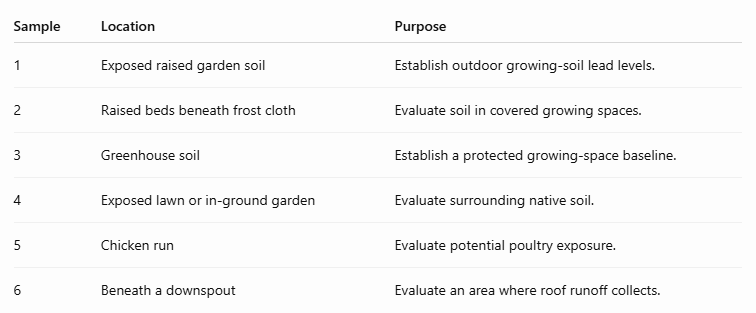
At a laboratory charging $23 per sample, six samples would cost $138, plus applicable shipping and fees.
I would also consider separately testing our collected rainwater and establishing baseline soil lead concentrations at our northern Michigan property.
These results would give me valuable information about our different growing environments and help me make informed decisions in the future.
A difference between covered and uncovered beds would not, by itself, prove that a particular environmental event caused contamination. Soil composition, property history and previous gardening practices may also explain differences.
Soil Lead Testing Checklist
Before collecting your samples:
Research your property's history.
Identify potential sources of lead.
Select a qualified testing laboratory.
Confirm testing prices and requirements.
Request total soil lead analysis.
Draw a map of sampling locations.
Gather clean sampling tools.
Collect samples from distinct areas separately.
Record sampling depths and dates.
Label every sample.
Complete the laboratory submission form.
Mail or deliver your samples.
Save your laboratory results.
Compare future results using consistent sampling and testing methods.
Adjust your gardening practices as necessary.
Keep a Record of Your Soil
I encourage gardeners to keep a permanent record of their soil test results.
You can create a simple notebook or spreadsheet that tracks the following information:
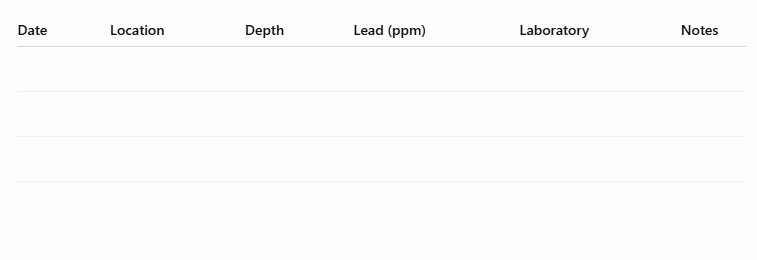
Keep photographs of sampling locations and copies of the original laboratory reports.
If you ever need to repeat testing following an environmental incident, you will have something to compare your new results against.
Whenever possible, use the same sampling locations, depths and laboratory methods so the results are more comparable.
Know Your Soil. Protect Your Garden.
One of the things I teach through The Lazy Northern Gardener is that successful gardening begins with understanding your own growing environment.
Knowing your soil isn't just about knowing whether you have sand or clay, whether you need compost or whether your plants need fertilizer.
It also means understanding what may already be present in your soil and what you could unintentionally introduce into it.
I'm not suggesting that every gardener should be afraid of their soil. I'm suggesting that information gives us more control over our gardening decisions.
A soil lead test is one more tool we can use to protect our gardens, our families and the food we work so hard to grow.
Need Help Understanding Your Growing Environment?
Whether you're starting your first garden, evaluating an existing growing space or trying to make your garden easier to maintain, I can help you understand your property and develop a practical gardening plan.
As a Master Gardener and Gardenary-Certified Garden Consultant, I offer on-site garden consultations from Macomb County to the tip of Michigan's Thumb, as well as virtual consultations.
Visit my Garden Consultation page to learn more.
For environmental contamination investigations and interpretation of potential health risks, always consult a qualified environmental professional or public health agency.
I Grow Gardeners.
— The Lazy Northern Gardener
Additional Resources
MSU Extension — Testing for Contaminants in Soil, Water and Plants
University of Maine Extension — Know Your Soil: Lead in the Soil
University of Massachusetts Extension — Soil Lead Testing, Interpretation and Recommendations
This article is for general gardening education. Testing prices and environmental recommendations may change. Contact your laboratory, local health department or environmental professional for guidance specific to your property.