Practical steps to protect your soil, food, rainwater and homestead
By The Lazy Northern Gardener | November 27, 2026
As gardeners, we spend years building healthy soil. We add compost, collect rainwater, mulch our garden beds and encourage the biological activity that helps our plants thrive. But what happens when something outside of our control threatens that soil?
Following the November 25, 2026, controlled detonation of lead azide at the Iowa Army Ammunition Plant, I watched a video by Ashley from Gardening in Canada discussing how lead can enter our gardens and move throughout our properties.
It got me thinking about our own Michigan homestead. We collect rainwater, raise chickens, grow food in raised beds, have a greenhouse and routinely use leaves and other natural materials to mulch our gardens.
All of these are practices I encourage gardeners to adopt. However, understanding how environmental contaminants move may occasionally require us to adjust those practices.
As of this writing, initial EPA air monitoring following the Iowa incident has been encouraging, with no detectable airborne lead reported by its real-time monitors in the monitored region. Additional environmental testing is underway. There is currently no established evidence that this incident contaminated Michigan gardens.
Regardless of the outcome, there are some valuable lessons here for gardeners everywhere.
I don't want gardeners to become afraid of gardening, collecting rainwater, using leaves as mulch or growing their own food.
Quite the opposite.
I want gardeners to understand their growing environments well enough to make informed decisions when circumstances change.
Where Can Lead in Your Garden Come From?
An industrial incident isn't the only potential source of lead contamination. Some gardeners may already have elevated levels of lead in their soil without realizing it.
Potential sources include:
Deteriorating lead-based paint from buildings constructed before 1978.
Industrial emissions and airborne dust.
Historic emissions from leaded gasoline near roadways.
Former orchards where lead-based pesticides were used.
Old burn piles.
Contaminated imported topsoil, fill or compost.
Roofing materials, flashing and older gutters containing lead.
Floodwater and stormwater runoff.
Demolition and construction debris.
Former shooting ranges.
Naturally occurring lead in the soil's parent material.
Knowing the history of your property is an important part of protecting your garden.
Why Lead Is Different From Other Garden Contaminants
Lead is an element. Unlike some pesticides and other organic contaminants, it cannot be broken down into harmless substances through normal decomposition.
You cannot compost it away, and you cannot simply water it out of your garden.
Although soil chemistry can change how tightly lead is bound to soil particles and how available it is to plants, the lead itself remains present unless it is physically or otherwise successfully removed.
Lead can move around your property through:
Windblown dust.
Rainfall and surface runoff.
Melting snow.
Soil erosion.
Digging and tilling.
Movement of contaminated leaves, mulch and compost.
Shoes, garden tools and animals.
Under certain soil conditions, some lead can also move in dissolved form through water.
Preventing contamination in the first place is considerably easier than dealing with it afterward.
1. Understand What Heavy Rainfall Does to Lead
Here in Michigan, we've experienced considerable rainfall recently. That got me wondering whether rain helps protect us from airborne contaminants or whether it simply moves them somewhere else.
The answer is that it can do both.
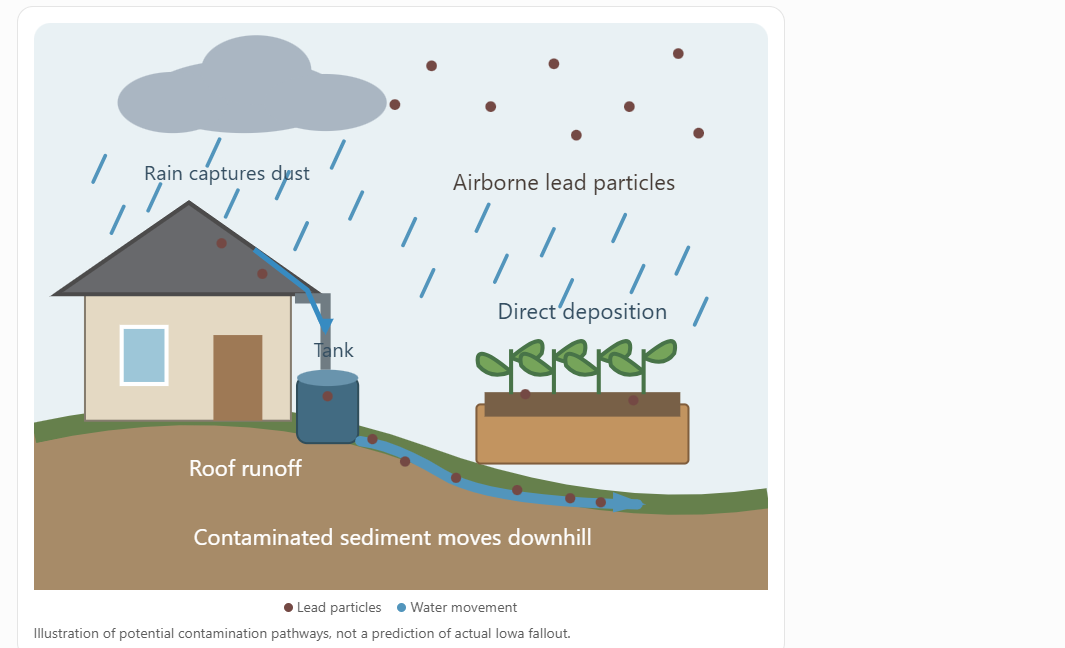
Rain can bring airborne particles to the ground
When rain falls through air containing lead particles, it can capture some of those particles and deposit them onto surfaces below.
That may include:
Rooftops
Lawns
Garden beds
Trees and shrubs
Greenhouse roofs
Ponds
Pastures
Compost piles
This can reduce the amount of airborne dust, but it does not eliminate the lead.
Rain can move contamination across your property
Once particles have settled, additional rainfall can carry contaminated dust and sediment away from their original location.
Water running off a roof may deposit contaminants beneath a downspout. Water flowing across a driveway may deposit sediment in a nearby garden. Water traveling downhill may carry material into low-lying areas where it accumulates.
Heavy rainfall can also splash contaminated soil onto vegetables growing close to the ground.
Rain can temporarily reduce dust
Wet soil is less likely to become airborne than dry soil. This can temporarily reduce exposure through windblown dust. However, once the soil dries, those particles can become airborne again.
The same concerns apply to snow. Snow can collect airborne contaminants and subsequently redistribute them when it melts.
The takeaway is that rainfall can change where lead is located, but it cannot make lead disappear. Rainfall by itself is also not evidence of contamination. There must be a source of lead present for rain to transport it.
2. Temporarily Disconnect Rainwater Collection Systems When Necessary
On our homestead, we capture rainwater to use in our gardens. It is a resource I don't particularly want to give up.
However, if there is a credible risk of airborne contamination in our area, temporarily disconnecting the collection system is one of the simplest precautions I can take.
A roof is essentially one large collection surface. Anything deposited onto that roof can potentially be washed into our gutters and rainwater storage tanks.
What gardeners can do
Disconnect rain barrels or storage tanks from their downspouts when a contamination event threatens their area.
Securely cover the openings of storage containers.
Keep previously collected water separate from newly collected water.
Redirect roof runoff away from vegetable gardens, livestock areas and wells.
Temporarily use a known-safe water source.
Arrange laboratory testing if contamination is suspected.
Clean affected gutters and collection equipment safely before reconnecting the system.
Water collected before a potential exposure does not automatically need to be discarded if it has remained protected. However, water collected during or after a credible contamination event should not be used on food crops or given to animals until its safety has been established.
If testing confirms contamination, contact your local environmental or health department for disposal instructions. Don't simply empty the tank into your garden or storm drain.
A first-flush diverter can also help reduce the amount of material washed from a roof into a collection tank during ordinary rainfall, although it cannot guarantee that the water is free of lead.
3. Protect Your Raised Beds and Containers
One advantage of raised-bed gardening is that we have considerably more control over our growing environment.
We can choose what soil goes into our beds, what water we use and what materials come into contact with that soil.
Currently, I have frost cloth over my raised beds here in Michigan. However, I installed it for frost protection, not protection from environmental contaminants.
There is a difference. Frost cloth allows air and moisture to pass through it. While securing it more tightly may help reduce some exposure to airborne debris, it will not reliably prevent fine lead particles or contaminated rainwater from reaching the soil.
If there is a credible contamination warning in your area, consider using a waterproof barrier instead.
Ways to protect garden beds
Move portable containers into a sheltered location.
Temporarily cover dormant raised beds with waterproof tarps.
Use securely attached greenhouse plastic over garden hoops.
Prevent water from pooling on top of covers.
Direct water running off covers away from the growing area.
Cover unused potting soil and soil storage containers.
Protect stored compost and mulch.
If you are covering actively growing plants with plastic, monitor temperatures. Even on a cold day, sunshine can quickly overheat plants beneath clear plastic.
When removing potentially contaminated covers, avoid shaking them or dumping collected debris into your garden. Fold the contaminated surface inward and follow local guidance for cleaning or disposal.
There is no universal number of days that guarantees an area is safe following a contamination event. Follow monitoring results and local environmental guidance rather than relying on an arbitrary waiting period.
4. Consider Growing Food in a Greenhouse
This is another reason I'm thankful we have a greenhouse on our homestead.
A greenhouse provides an additional barrier between our growing space and the outside environment. It can help protect plants and soil from direct rainfall, airborne debris and contaminated surface runoff. For gardeners who live near industrial areas or have concerns about their existing soil, a greenhouse combined with container gardening may offer additional protection.
To get the most protection from a greenhouse:
Use clean soil from a reliable source.
Grow in raised beds, pots or containers.
Use a known-safe water source.
Prevent outdoor runoff from entering the greenhouse.
Keep potentially contaminated tools and footwear outside.
Manage ventilation appropriately during an official airborne contamination warning.
Avoid collecting potentially contaminated runoff from the greenhouse roof.
A greenhouse is not airtight. Dust can enter through doors, vents, fans and roll-up sides, so it should be considered an additional layer of protection rather than a complete solution.
5. Pay Attention to Where Water Flows
When was the last time you walked around your property during a heavy rainstorm?
Watching where water travels can tell you a great deal about your property's potential exposure to contaminants.
Look for water:
Running off rooftops.
Crossing driveways.
Entering garden beds from surrounding lawns.
Flowing downhill from neighboring properties.
Collecting in depressions.
Pooling around compost bins.
Entering chicken runs or livestock areas.
Gardeners can reduce unwanted runoff by using raised beds, downspout extensions, vegetated buffer areas and appropriate drainage improvements. You may also need to adjust the grading around your garden to prevent surrounding surface water from entering it.
If contamination is already suspected, avoid digging trenches or disturbing the affected soil until you receive appropriate guidance. The goal is to protect our growing spaces without simply transferring contamination to another property, a waterway or a well.
6. Keep Your Soil Covered
If you've followed The Lazy Northern Gardener for any length of time, you know how much I encourage gardeners to keep their soil covered.
We can learn a lot from looking at the forest floor. Nature rarely leaves healthy soil exposed.
Mulching has many benefits, including moisture retention, weed suppression and temperature regulation. But it can also help reduce exposure to potentially contaminated soil.
A layer of clean mulch can:
Reduce windblown soil particles.
Reduce soil erosion during heavy rainfall.
Prevent soil from splashing onto vegetables.
Reduce direct contact with underlying soil.
Help prevent soil from being tracked into the house.
Suitable materials include clean wood chips, straw, leaves and compost from reliable sources. Remember, however, that mulch helps contain contamination. It does not remove lead from the soil underneath it.
7. Be Selective About Leaves, Grass Clippings and Compost
I regularly encourage gardeners to use what nature provides for free. Leaves, grass clippings and other organic materials can be valuable additions to our gardens.
However, we need to consider where those materials came from. If an area has experienced confirmed lead fallout or another credible contamination event, materials exposed to that event may carry lead particles into otherwise clean garden beds.
This includes:
Fallen leaves.
Grass clippings.
Straw and hay.
Wood chips.
Uncovered compost.
Animal bedding.
Imported topsoil.
Composting contaminated organic materials does not destroy the lead. As organic matter decomposes, lead can remain behind and may become more concentrated relative to the remaining material.
If contamination is suspected, keep those materials separate until testing or environmental guidance establishes what should be done with them.
Avoid using a leaf blower, lawn mower or shredder on potentially contaminated material, as these activities may put settled dust back into the air.
There is no reason to discard healthy leaves or compost solely because an incident occurred somewhere else. Make your decisions based on the likelihood of local exposure.
8. Understand How Your Soil Type Affects Lead
Not all soils behave the same way. Clay soils and soils containing substantial organic matter generally have a greater capacity to bind lead particles. Sandy soils typically have fewer binding sites. Under some conditions, this can make lead more mobile or more available for plant uptake.
Here on our Michigan homestead, we have sandy loam soil. At our northern property, the soil is even sandier. For gardeners like me, this is another reason to continue building healthy soil using clean organic materials.
Soil pH also matters. More acidic soil can increase lead availability.
What gardeners can do
Test soil pH.
Maintain a near-neutral pH, generally around 6.5–7.0 for most vegetable gardens.
Add clean, well-aged compost.
Reduce soil disturbance.
Maintain protective vegetation and mulch.
Apply lime or other amendments only according to soil test recommendations.
These practices may reduce the mobility and plant availability of lead, but they do not remove existing contamination.
9. Choose What You Grow and Where You Grow It
Lead can enter our food in two primary ways: through contaminated particles sticking to the outside of vegetables and through absorption into plant tissue.
Different crops present different levels of potential exposure.
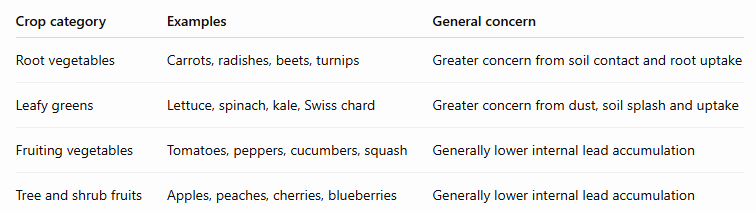
Lower risk does not mean zero risk. Contaminated dust can settle on any crop.
If your property's soil has elevated lead levels, prioritize growing edible crops in containers or raised beds filled with tested, clean soil, particularly root vegetables and leafy greens.
Do not assume that choosing tomatoes instead of carrots makes heavily contaminated soil suitable for food production.
Before bringing produce into your kitchen
Wash vegetables thoroughly under clean running water.
Remove soil from root crops outdoors.
Peel root vegetables when appropriate.
Remove outer leaves from leafy vegetables.
Wash your hands after harvesting.
Washing helps remove surface contamination, but it cannot remove lead already absorbed into plant tissue.
If produce has been directly exposed to a significant contamination event, consult your local health department before consuming it.
10. Protect Your Backyard Chickens and Other Animals
For those of us with backyard poultry, soil contamination presents another concern.
Chickens spend much of their day scratching, pecking and consuming small amounts of soil. They may also ingest contaminated vegetation, insects and water.
Lead exposure in chickens can potentially result in lead accumulating in their bodies and transferring into their eggs.
If there is a credible contamination warning:
Cover stored chicken feed.
Protect hay, straw and bedding.
Provide clean drinking water.
Restrict access to potentially contaminated soil.
Avoid feeding potentially contaminated garden scraps.
Provide a protected run with clean flooring or bedding where practical.
Consult a veterinarian or agricultural extension office about testing animals or eggs when warranted.
The same general precautions apply to other livestock and household pets. Pets can also carry contaminated dust indoors on their paws and fur.
11. Establish a Baseline With Soil Testing
One of the most valuable things gardeners can do is establish what is already present in their soil.
Most of us think about soil testing in terms of nitrogen, phosphorus, potassium and pH. However, routine garden soil tests do not always include heavy metals.
You may need to specifically request testing for total lead.
Not sure how to collect a soil sample, where to send it or what your results mean? I've created a separate step-by-step guide that includes affordable testing laboratories, sampling instructions, testing costs and recommendations for interpreting your results.
Read more: How to Test Your Garden Soil for Lead.
Consider testing:
Raised garden beds.
In-ground vegetable gardens.
Greenhouse soil.
Children's play areas.
Chicken runs.
Soil near older buildings.
Areas beneath downspouts.
Low-lying areas where runoff collects.
Soil near roads or former industrial properties.
Imported soil and compost when their history is questionable.
Keep samples from different areas separate. Combining soil from your entire property could conceal a localized area of elevated contamination.
Keep a record of your results, sampling locations and sampling dates. This gives you a reference point if you ever need to investigate a future contamination event.
Use a laboratory qualified to perform environmental lead testing. Home lead paint swabs are not an adequate substitute for laboratory testing of soil, collected rainwater or environmental dust.
Your local Cooperative Extension office or health department can help you identify appropriate testing services and interpret the results.
12. Avoid Moving Potentially Contaminated Soil
If you suspect lead contamination, resist the urge to immediately clean up your entire property.
Some well-intentioned activities can actually redistribute contamination.
Avoid:
Rototilling contaminated surface soil into deeper soil layers.
Using leaf blowers on potentially contaminated surfaces.
Dry sweeping contaminated dust.
Moving questionable soil into raised beds.
Pressure washing contaminants toward gardens or waterways.
Burning potentially contaminated leaves or other materials.
Attempting to flush lead out of garden soil with excessive watering.
Using sunflowers or other plants as a substitute for professional remediation.
Keep garden footwear outside your living area, wash your hands after working outdoors and use damp cleaning methods for ordinary dust control.
Significant contamination may require professional soil removal, capping or other environmental remediation.
My Garden Protection Checklist
These are the things I will be reviewing on our own homestead and that you can review on your property, too.
Evaluate potential lead sources around the property.
Establish a baseline soil lead test.
Make sure rainwater collection systems can be easily disconnected.
Keep stored water covered.
Identify a backup source of clean water.
Inspect garden bed covers and fasteners.
Keep waterproof covers available for emergencies.
Evaluate greenhouse ventilation and drainage.
Observe where water travels during heavy rainfall.
Keep garden soil and pathways mulched.
Protect stored compost and potting soil.
Know the source of imported garden materials.
Protect chicken feed, bedding and drinking water.
Follow credible local environmental monitoring and advisories.
Keep records of soil and water testing.
Protecting Our Soil Is Protecting Our Future
I don't want gardeners to become afraid of gardening, collecting rainwater, using leaves as mulch or growing their own food.
Quite the opposite.
I want gardeners to understand their growing environments well enough to make informed decisions when circumstances change.
Many of the practices I already encourage through The Lazy Northern Gardener - raised-bed gardening, keeping soil covered, reducing unnecessary tilling, adding clean organic matter and observing how water moves through your property - can also help reduce our exposure to environmental contaminants.
We cannot control everything that happens outside our property lines. But we can have considerably more control over what we introduce into our gardens and how we manage our growing spaces.
Protect the soil you have worked so hard to build. Test when necessary, take reasonable precautions and make decisions based on evidence rather than fear.
Need Help Evaluating Your Garden?
Every property is different. Your soil, drainage, growing spaces, surrounding landscape and water sources all influence how you should manage your garden.
As a Master Gardener and Gardenary-Certified Garden Consultant, I help gardeners understand their properties and create easier, more manageable gardens.
I offer on-site garden consultations from Macomb County to the tip of Michigan's Thumb, as well as virtual consultations.
Visit my Garden Consultation page to learn more.
I Grow Gardeners.
— The Lazy Northern Gardener
Sources and Additional Reading
Gardening in Canada - Ashley's educational video discussing lead movement and garden protection, which inspired this article.
EPA: Healthy Gardening Practices to Reduce Exposure to Lead-Contaminated Soil
Michigan Department of Health and Human Services: Lead in Soil
Iowa State University Extension: Addressing Concerns of Lead in Garden Soils
EPA: November 26, 2026, Iowa Detonation Environmental Sampling Update
This article is intended for general gardening education and is not a substitute for site-specific environmental testing, medical advice or professional contamination remediation.